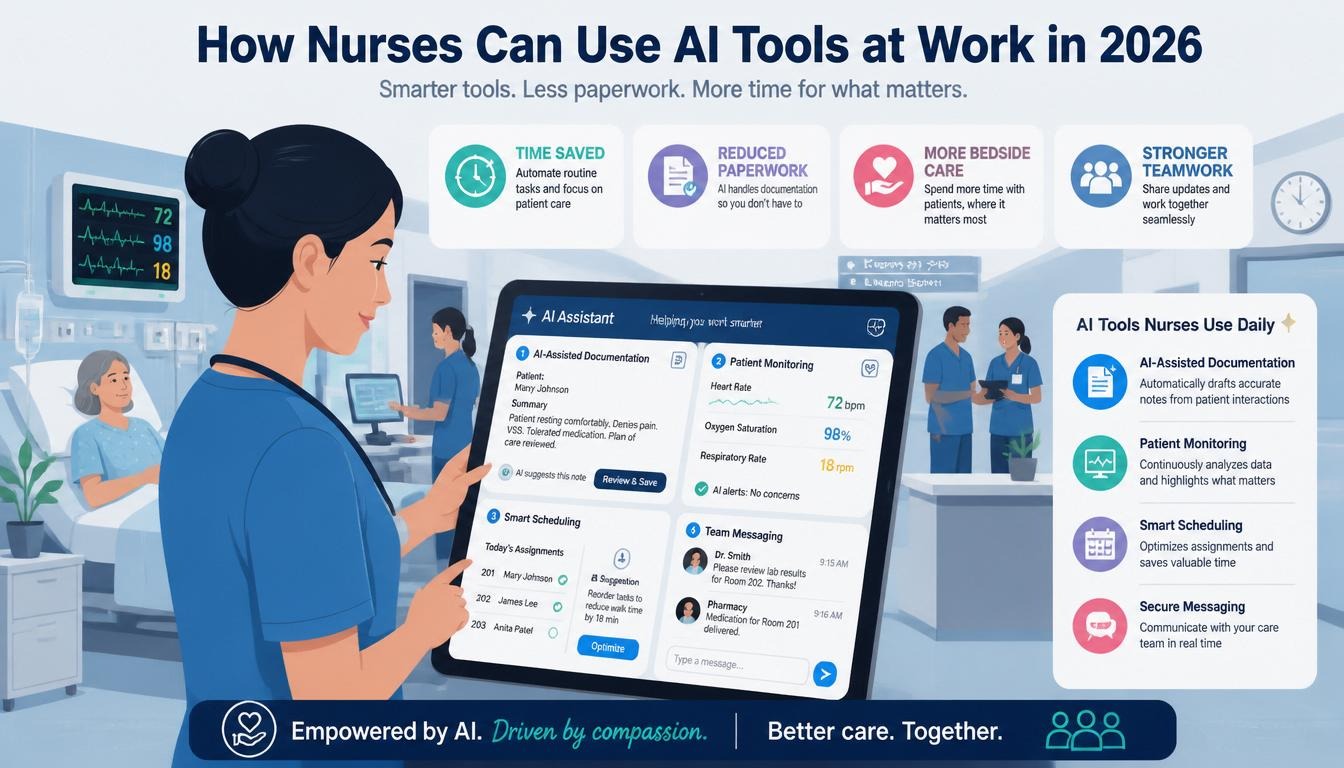
How Nurses Can Use AI Tools at Work in 2026
How nurses can use AI tools at work is transforming one of the most demanding professions in American healthcare. Nurses are the backbone of every hospital, clinic and care facility in the United States yet they spend a staggering amount of their shifts on documentation, administrative tasks and repetitive communication that pulls them away from direct patient care. In 2026 AI tools are giving nurses back something invaluable time. Time to spend at the bedside. Time to notice the subtle changes in a patient’s condition. Time to actually be present in the moments that matter most in nursing care.
The Real Challenge Nurses Face Every Day
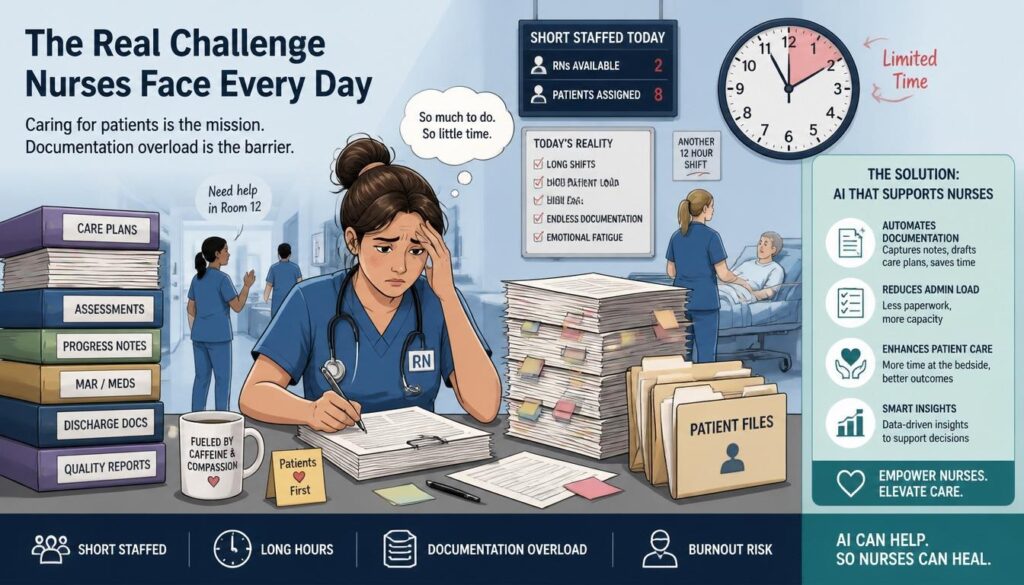
American nurses are stretched dangerously thin. The nursing shortage in the United States has reached critical levels with millions of unfilled positions across the country. Those who remain are handling larger patient loads, longer shifts and more administrative responsibility than any previous generation of nurses has faced.
According to the American Nurses Association at nursingworld.org, documentation alone accounts for up to 25% of a nurse’s total shift time. That is two hours of every eight-hour shift spent on paperwork rather than patients. AI tools are directly addressing this crisis by automating the most time-consuming documentation and administrative tasks allowing nurses to redirect their energy toward the hands-on patient care that only they can provide.
How Nurses Can Use AI for Patient Documentation
Patient documentation is the most immediate and impactful area where AI tools save nurses significant time every shift. Nursing notes, care plans, shift handover reports and patient education documentation all require precise, detailed writing that consumes enormous time when done entirely manually. AI tools are transforming this process in ways that genuinely change how nurses experience their working day.
Claude is particularly well suited for nursing documentation because of its ability to produce clear, accurate clinical language quickly. Nurses are using Claude to draft initial versions of nursing notes and care plans from brief inputs then reviewing and finalizing rather than writing every word from scratch. This workflow change alone saves many nurses 45 minutes to an hour every single shift. For nurses already working through exhausting twelve-hour shifts, that time savings is genuinely life-changing in terms of energy and wellbeing.
How Nurses Can Use AI for Patient Education
Educating patients about their conditions, medications and discharge instructions is one of the most important responsibilities nurses carry and one of the most time-consuming to do well. Every patient is different. Every health literacy level is different. Creating clear, personalized patient education materials from scratch for every patient encounter is simply not sustainable given current nursing workloads.
Claude and ChatGPT are transforming patient education by helping nurses create clear, accurate and personalized education materials in minutes rather than hours. A nurse can describe a patient’s specific situation, medications and discharge needs and receive a complete, plain-language patient education document ready for review and printing. For nurses who want to improve patient outcomes through better education without sacrificing additional time, AI tools make genuinely personalized patient education achievable for the first time at scale.
How Nurses Can Use AI for Clinical Research and Continuing Education
Staying current with nursing best practices, updated clinical guidelines and evidence-based care protocols is a professional requirement for every registered nurse but finding time to engage with new research during an already demanding career is genuinely difficult. AI tools are making it easier for nurses to stay current without adding to their already heavy workload. Gemini is particularly powerful for nursing research applications because of its real time Google Search integration.
Nurses can quickly ask about updated wound care protocols, current medication guidelines or recent changes to clinical best practices and receive accurate, current summaries in seconds. For nurses who want to stay at the forefront of evidence-based practice without spending their limited off-shift time buried in clinical journals, Gemini provides a research capability that was simply not available to previous generations of nursing professionals.
How Nurses Can Use AI for Shift Handover Communication
Shift handover is one of the highest-risk moments in patient care. Incomplete or unclear communication during handover directly contributes to patient safety incidents across healthcare systems worldwide. Creating comprehensive, clear handover reports that accurately capture every patient’s current status, recent changes and upcoming care needs is critical and time-consuming under shift-end pressure.
AI tools are helping nurses create more comprehensive and consistent handover reports in less time. By using ChatGPT or Claude to structure handover notes from brief inputs about each patient, nurses can produce clearer, more complete handover communications even during the most chaotic end-of-shift moments. Better handover communication directly improves patient safety outcomes making this one of the most impactful applications of AI tools in nursing practice today.
How Nurses Can Use AI for Care Planning
Developing individualized nursing care plans requires significant clinical knowledge, documentation skill and time. For nurses managing multiple patients simultaneously, creating thorough, individualized care plans for every patient is one of the most challenging documentation requirements of the job. AI tools are making this process significantly more manageable without compromising the quality or individualization of patient care.
Nurses are using Claude to generate initial care plan frameworks based on patient diagnoses, current medications and identified nursing problems then customizing and reviewing those frameworks using their own clinical judgment and patient knowledge.
This collaborative approach between human clinical expertise and AI efficiency produces care plans that are both thorough and genuinely individualized. According to healthit.gov, AI-assisted care planning is emerging as one of the most promising applications of health information technology in nursing practice across US healthcare systems.
How Nurses Can Use AI for Professional Communication
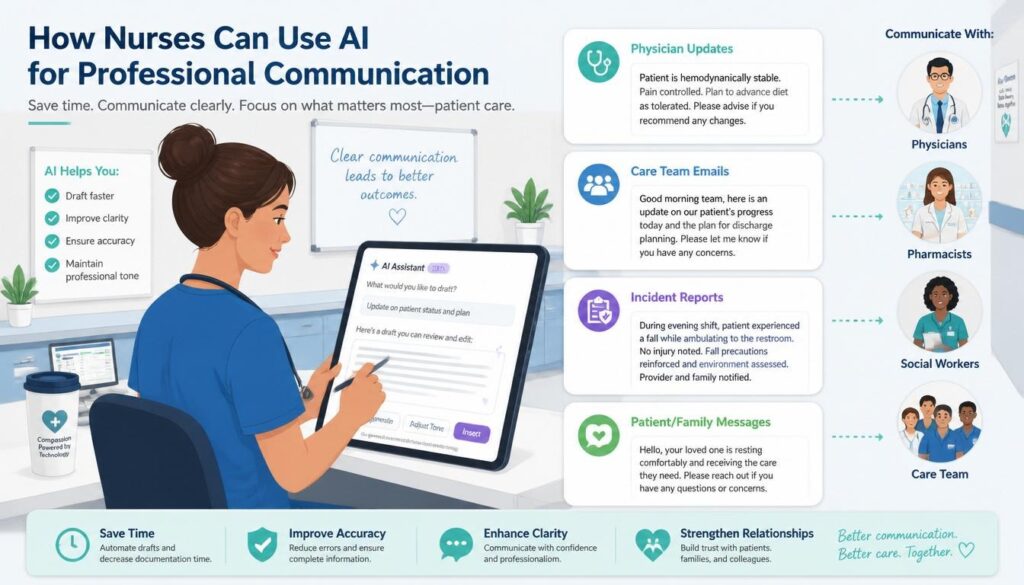
Nurses communicate constantly with patients, families, physicians, pharmacists, social workers and administrators. Drafting clear, professional written communications across all of these relationships takes significant time that nurses often do not have. AI tools are helping nurses communicate more effectively and efficiently across every professional relationship in their practice.
ChatGPT is particularly useful for nursing communication tasks. It helps nurses draft clear messages to physicians about patient status changes, professional emails to care team members, formal incident reports and patient family updates that are both accurate and compassionate. For nurses who want to improve their professional communication without spending additional time crafting every message from scratch, ChatGPT delivers results that enhance both efficiency and professional relationships.
Conclusion
How nurses can use AI tools at work in 2026 ultimately comes down to one transformative possibility: giving nurses back the time and energy they need to actually nurse. Claude leads for patient documentation and care planning with accurate clinical language that reduces charting time dramatically every shift. ChatGPT leads for patient education and professional communication with versatility across every documentation and communication need nurses face.
Gemini keeps nurses current with real time access to updated clinical guidelines and evidence-based practice resources. Used thoughtfully and within appropriate clinical boundaries, AI tools are not replacing the irreplaceable human skills that define excellent nursing; they are removing the administrative burden that prevents nurses from using those skills to their fullest every single day.
FAQs
Can nurses legally use AI tools for patient documentation?
Yes, nurses can use AI tools to assist with documentation drafting. Always review AI-generated content carefully and never enter patient identifying information into public AI platforms.
Which AI tool is best for nurses?
Claude is best for documentation and care planning. Gemini is best for clinical research. ChatGPT is best for versatile communication and patient education material creation.
How much time can AI save nurses every shift?
Most nurses using AI documentation tools report saving 45 minutes to one hour per shift primarily through faster nursing note drafting and patient education material creation.
Is AI replacing nurses in hospitals?
Absolutely not. AI handles administrative and documentation tasks; the irreplaceable clinical judgment, emotional intelligence and hands-on care that nurses provide cannot be replicated by any AI tool.
Can AI help nurses with patient education materials?
Yes. Claude and ChatGPT create clear, personalized patient education documents in plain language helping nurses improve patient understanding and outcomes without additional time investment.
Is it safe for nurses to use ChatGPT at work?
ChatGPT is safe for administrative tasks and communication drafting. Never enter patient names, dates of birth or identifying information into any public AI platform to maintain HIPAA compliance.
Can AI help with nursing shift handovers?
Yes. AI tools help nurses create more comprehensive and consistent handover reports quickly improving communication clarity and patient safety during one of the highest-risk moments in care.
What should nurses avoid when using AI tools?
Never input confidential patient information. Always verify AI-generated clinical content with your own judgment. Follow your hospital’s specific policies on AI tool use in clinical settings.