Can AI Really Write Better Than Humans in 2026
Can AI really write better than humans in 2026 is a question that divides writers, marketers and readers into passionate camps with strong opinions. Some insist AI has already surpassed human writing capability. Others dismiss AI content as soulless and mechanical regardless of how sophisticated it becomes. The truth, as usual, is more nuanced than either extreme position suggests.
AI writing tools have improved dramatically and now genuinely excel at certain writing tasks while remaining fundamentally limited in others. Understanding exactly where AI excels and where human writers still hold irreplaceable advantages matters enormously for anyone making decisions about content creation in 2026.
Where AI Genuinely Outperforms Human Writers
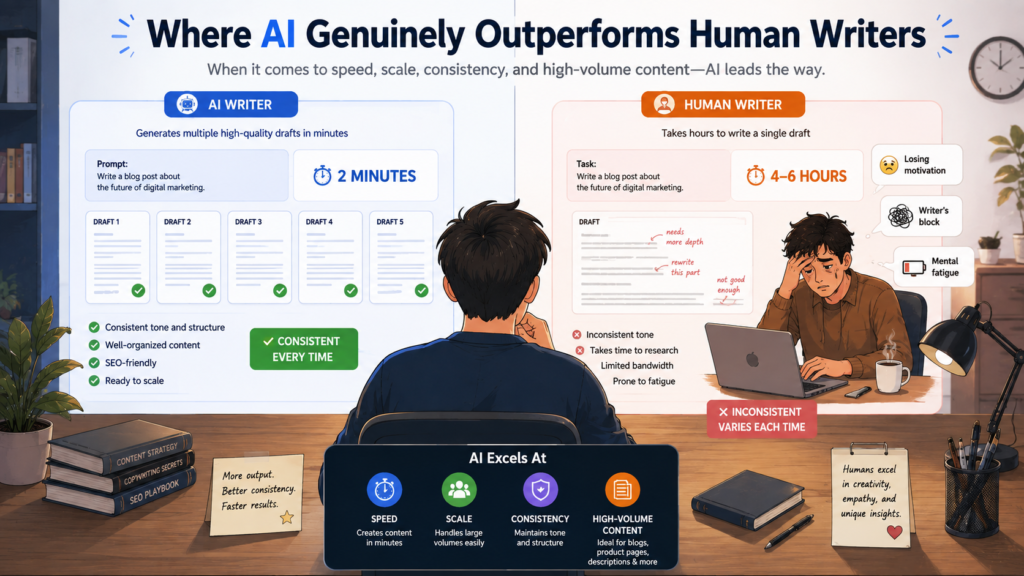
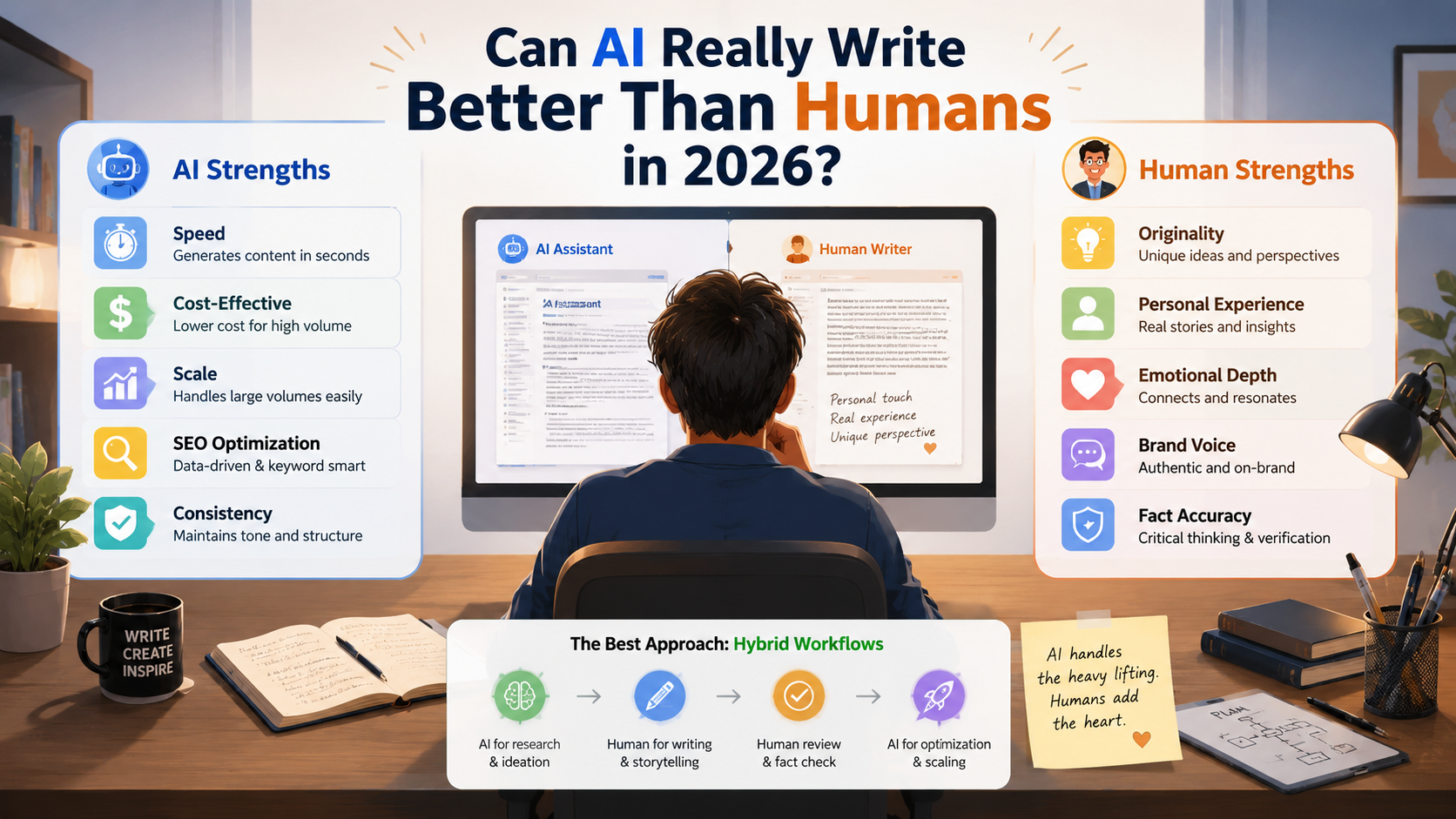
AI tools like Claude and ChatGPT now genuinely outperform most human writers in several specific dimensions. Speed is the most obvious advantage AI produces publication-ready drafts in minutes that would take skilled human writers hours to complete.
This speed advantage alone has transformed content production economics across every industry that relies on written content at scale. Consistency represents another area where AI genuinely exceeds typical human performance.
AI tools maintain identical quality, tone and structure across hundreds of pieces of content without the fatigue, mood variations or inconsistency that naturally affects human writers producing high volumes of content.
According to research from MIT at mit.edu, AI language models demonstrate remarkable consistency in maintaining stylistic patterns across extended content generation that human writers struggle to match when producing content at similar volumes and speeds.
Where Human Writers Still Maintain Clear Advantages
Despite AI’s impressive capabilities, human writers maintain advantages current technology has not replicated. Genuine lived experience remains entirely human territory the specific feeling of a difficult conversation, or the authentic joy of an unexpected success, comes from real human experience AI cannot possess.
Original insight also remains distinctly human. AI excels at recombining existing patterns, but the genuine creative leaps that define great writing as an unexpected metaphor, a structural innovation still emerge from human creativity in ways AI has not consistently matched.
According to Wired at wired.com, even the most advanced AI writing systems continue to struggle with the genuine originality that distinguishes truly exceptional human writing from merely competent content production.
The Quality Question Depends Entirely on the Writing Task
Whether AI writes better than humans depends enormously on the specific writing task under consideration. For straightforward informational content product descriptions, basic explanations, routine business communications AI often produces results that are equal to or better than average human writers, particularly when those human writers are working under time pressure or lack specialized expertise in the topic.
For content requiring genuine emotional resonance, deep personal experience or creative originality memoir writing, literary fiction, deeply personal essays human writers maintain clear advantages that current AI technology has not closed.
The question is not really whether AI writes better than humans universally but rather which specific writing tasks benefit most from AI assistance versus which tasks still require primarily human creative and emotional intelligence to execute successfully.
How AI Writing Quality Has Changed Public Perception
Public perception of AI writing has shifted dramatically as tools like Claude have demonstrated writing quality that genuinely surprises even skeptical observers. Early AI writing tools produced content that readers could easily identify as artificial awkward phrasing, repetitive structures and a distinctly mechanical quality that undermined reader engagement and trust.
Modern AI writing tools have largely eliminated these obvious tells, producing content that reads naturally enough that readers often cannot reliably distinguish AI-generated content from human writing without explicit disclosure. This shift has profound implications for content creators, publishers and readers navigating a media landscape where the traditional assumption that written content came from human authors no longer holds reliably true across the internet.
The Hybrid Approach That Actually Produces the Best Results
Rather than framing this as a binary competition between AI and human writers, the most successful content creators in 2026 have discovered that hybrid approaches combining AI capabilities with human judgment consistently outperform either approach used in isolation.
AI handles the heavy lifting of initial drafting, research synthesis and structural organization while human writers provide the strategic direction, authentic voice and quality judgment that elevates AI-assisted content beyond what either humans or AI could produce independently.
This hybrid approach leverages AI’s genuine strengths, speed, consistency and broad knowledge synthesis while compensating for AI’s genuine limitations through human oversight, editing and the addition of authentic personal insight that AI cannot independently generate. Writers who have mastered this collaborative approach report producing higher quality content faster than either pure human writing or unedited AI generation could achieve alone.
What This Means for Professional Writers and Content Creators
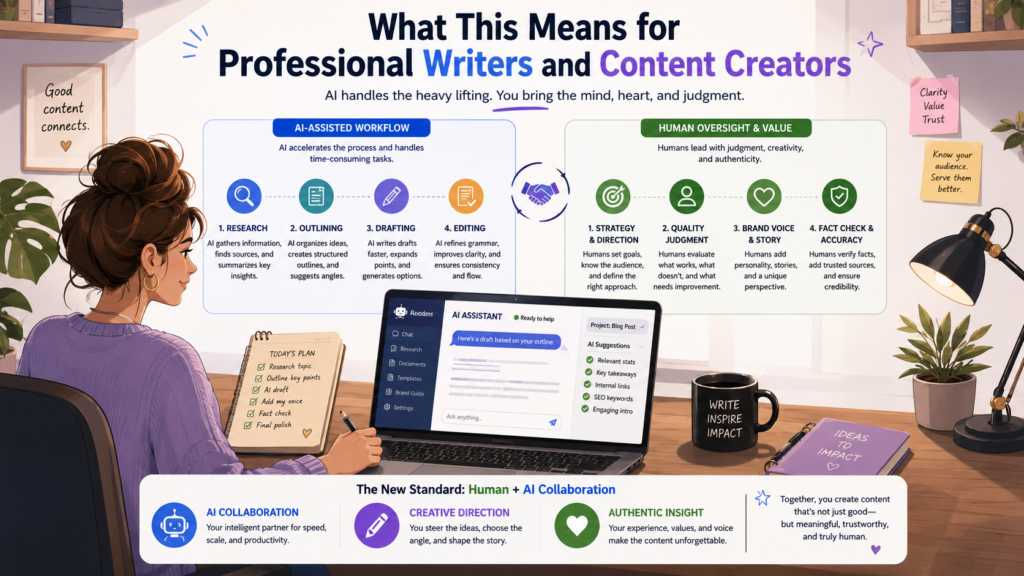
For professional writers navigating this evolving landscape, the practical question is not whether AI will replace human writing entirely but rather how writers can most effectively integrate AI capabilities into their existing skills and processes.
Writers who view AI as a threat to be resisted often find themselves increasingly inefficient compared to peers who have learned to leverage AI capabilities while maintaining the human judgment and creative direction that AI cannot independently provide.
The writers thriving in 2026 are typically those who have shifted their value proposition from pure content production toward strategic direction, quality judgment and the authentic human insight that elevates AI-assisted content above generic AI output. This shift requires developing new skills around effective AI collaboration rather than either wholesale AI adoption or stubborn resistance to incorporating AI capabilities into established writing workflows.
Conclusion
Can AI really write better than humans in 2026 depends on which capability you’re evaluating. AI exceeds human performance in speed, consistency and synthesizing information quickly. Human writers hold advantages in authentic emotion, creative originality and lived experience that gives writing its irreplaceable power.
The most productive view isn’t a competition with one winner AI and humans excel at genuinely different aspects of writing. The content creators succeeding in 2026 aren’t choosing between them; they’re combining both strategically to produce results neither could achieve alone.
FAQs
Is AI writing actually good enough to replace human writers?
For certain content types like basic information and routine communication, yes. For content requiring genuine creativity, emotional depth or personal experience, human writers remain irreplaceable.
Can readers tell the difference between AI and human writing?
Increasingly difficult. Modern AI tools like Claude produce content that reads naturally enough that most readers cannot reliably distinguish AI writing from human writing without explicit disclosure.
What types of writing does AI do best?
AI excels at informational content, product descriptions, structured business communication and content requiring consistency across large volumes rather than deep emotional or creative originality.
What types of writing still require human writers?
Memoir, literary fiction, deeply personal essays and content requiring genuine lived experience or creative breakthrough still benefit significantly from human writers over AI alone.
Should writers be worried about AI replacing their jobs?
Writers who adapt by learning effective AI collaboration typically thrive. Those who resist AI entirely or rely on AI exclusively without human judgment often struggle competitively.
Is hybrid AI-human writing better than either alone?
Yes, according to most content creators who have tested this approach. Combining AI speed and consistency with human judgment and authenticity typically produces the strongest results.
How has AI writing quality changed in recent years?
Dramatically. Early AI writing was easily identifiable as artificial. Modern tools like Claude produce content with natural flow and structure that closely resembles skilled human writing.
Will AI eventually write better than humans at everything?
Uncertain. While AI continues improving rapidly, genuine creative originality and authentic emotional expression remain areas where human advantages have proven more persistent than early predictions suggested.